Teachers will vary in their understandings of bilingualism and the processes of second language acquisition. Some teachers will be bilingual or plurilingual themselves and have a wealth of personal experience to draw on. Others may be very familiar with multilingual school environments. Some may have had no contact with bilingual or EAL learners.
Here we outline aspects of bilingualism and the development of first and additional languages which can inform teachers' approaches to bilingual and EAL learners in schools. Teachers should, for example, be aware that::
- The learner’s first or home language plays a significant role in the learning of the additional language in terms of cognitive, linguistic and socio-cultural influences.
- Learning a second language will not necessarily proceed in an orderly and systematic fashion. Learners will use prior linguistic, learned and world knowledge. They will learn when there is a need to communicate and to learn.
- Most EAL and bilingual learners will develop a functional level of English in the first two years of schooling in English but they will need continued support to develop the cognitive academic language proficiency necessary for academic success.
- Bilingual education can be very beneficial in the development of the second language
- Learning a language and becoming bilingual is also about learning and living in different societies and cultures. It is not just about acquiring a new language, but also about understanding another culture and developing another identity.
These materials provide an introduction to bilingualism and second language acquisition and its implications for the classroom. Most initial teacher training providers include sessions on bilingualism and second language acquisition within their programmes.
What is Bilingualism?
Put simply, bilingualism is the ability to use two languages. However, defining bilingualism is problematic since individuals with varying bilingual characteristics may be classified as bilingual. Definitions of bilingualism range from a minimal proficiency in two languages, to an advanced level of proficiency which allows the speaker to function and appear as a native-like speaker of two languages. A person may describe themselves as bilingual but may mean only the ability to converse and communicate orally. Others may be proficient in reading in two or more languages (or bi-literate). A person may be bilingual by virtue of having grown up learning and using two languages simultaneously (simultaneous bilingualism). Or they may become bilingual by learning a second language sometime after their first language. This is known as sequential bilingualism. To be bilingual means different things to different people.
Bilingualism encompasses a range of proficiencies and contexts. A young child entering school may be called bilingual but it may be that she uses her first or home language for domestic and familial purposes and that English is her preferred language for communication outside the home. Or she may be largely monolingual in her first language only when she starts school. A child who has recently arrived in England from overseas may have a good level of literacy in English but may be unable to converse or use spoken English in the classroom context. On the other hand, many pupils described as bilingual routinely use three languages or more and thus 'plurilingual' would be a better description. In terms of competence, a bilingual may have very high levels of proficiency in both languages or may have only limited proficiency in one and be far more proficient in the other.
The use of the term ‘bilingual’ is thus dependent upon: context; linguistic proficiency and purpose. Many educators use ‘bilingual pupils’ in preference to 'pupils learning EAL' in order to heighten awareness of pupils' linguistic knowledge and expertise as well as their cultural affiliations. Rampton (1990) suggested replacing terms such as 'native speaker' and 'mother tongue' with language expertise, language affiliation and language inheritance. These terms may help teachers to understand the complex nature of bilingualism and plurilingualism in multiethnic schools.
Bilingual Language Acquisition
In the same way as children learn their first language, sequential bilingual learners must also learn how to use their newly acquired language accurately and appropriately. Although the process of language learning may be similar, there are also differences. For example, bilingual learners address the process of learning another language already possessing knowledge of a linguistic system, its structures and rules. In addition, sequential bilingual learners start learning their second language at different ages, rather than from birth, and will be able to use different learning strategies.
Second language development would appear to proceed in an orderly fashion. Researchers have discovered that there is a fairly common sequence of acquisition for second language learners across a range of languages and contexts. What is not known is exactly what aspects of the second language are learned in what sequence. However it is known that some aspects are learned when there is a perceived need by the learner and some items can be learned in no particular sequence. Other research has suggested that there is a developmental sequence which precludes the early learning of certain items. Second language learners will demonstrate some of the stages of first language development. For example, they may go through a period when a rule is generalised to all instances. However, the rate of acquisition and the level of proficiency achieved in second language learning will depend upon the individual learner.
The popular belief that younger children have an advantage over adults in developing bilingually is not necessarily true. Early acquisition of the speech sound system of a language may result in a native-like pronunciation and the impression of fluency, but older learners may have an advantage in terms of increased metalinguistic awareness that enables them to learn the new language more quickly. For the young child, bilingual development is taking place alongside conceptual development and learning about the world. For older learners who have greater knowledge and understanding, it is the learning of new labels for objects, ideas and concepts already known.
As they learn the new language, second language learners incorporate the new linguistic input into their existing model of the language. There are many aspects of language that are common. For example all languages have ways of denoting time, of indicating actions and actors. Languages do this with different vocabularies and often with different grammars, but all languages are rule-governed. Part of the process of language acquisition involves the discovery and application of these rules. 'Interlanguage' is the term used to describe the language that learners produce as they learn the second language. It is also used to describe the evolving development of the learner's knowledge and use of the second language as they become increasingly proficient. It will change as the learner learns more and incorporates new linguistic knowledge into existing knowledge. Error analysis appears to suggest that the majority of interlingual errors are developmental and a sign of progress.
Learners and their learning strategies will change over time. A five year old will have a different language learning profile and language learning strategies than a fifteen year old. For bilingual learners, their first language knowledge will be helpful in the acquisition of the second language. The extent of this help will be dependent upon their proficiency in their first language, their age and other factors.
BICS and CALP
These terms are commonly used in discussion of bilingual education. They arise from the early work of Cummins (1984) in which he demonstrated his ideas about second language development in a simple matrix. BICS describes the development of conversational fluency (Basic Interpersonal Communicative Skills) in the second language, whereas CALP describes the use of language in decontextualized academic situations ( Cognitive Academic Language Proficiency ).
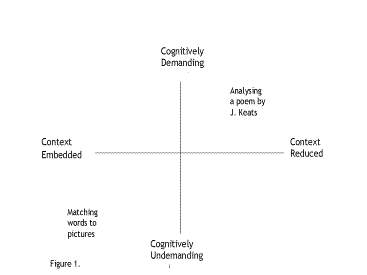
The horizontal axis of the BICS/CALP matrix represents a continuum from 'context-embedded' to 'context-reduced', ranging from the situation in which the learner uses external clues and information, such as facial gestures, real objects and pictorial representation to enable understanding, to the other extreme where the learner must rely on linguistic cues, and knowledge about language and text to understand meanings. The vertical axis relates to the degree of cognitive involvement in a task, and moves from tasks that are not very demanding to increasing challenging activities. So, an activity in the lower left corner (cognitively undemanding and context-embedded) such as matching words to a picture might be appropriate for a beginner, but tasks in the upper right corner (more cognitively demanding and context-reduced) such as a poem by Keats, would be a task for advanced learners. Cummins' model has proved helpful in identifying and developing appropriate tasks for bilingual pupils. For example, in preparing tasks for a newly arrived second language learner, teachers might start with contextualized tasks and practical activities that are of low cognitive demand, such as naming items or a simple matching exercise. More proficient learners would require contextual support, but would need more cognitively demanding tasks. This approach to planning and assessing EAL learners was developed and reported in Cline and Frederickson (1996).
In conceptualizing bilingual proficiency in this way, Cummins and other researchers suggest that it takes learners, on average, approximately two years to achieve a functional, social use of a second language but that it may take five to seven years or longer, for some bilingual learners to achieve a level of academic linguistic proficiency comparable to monolingual English speaking peers.
Common Underlying Proficiency
Cummins (1984 and 2000) also argues for a common underlying proficiency or interdependence hypothesis, in which cross-lingual proficiencies can promote the development of cognitive, academic skills. Common underlying proficiency refers to the interdependence of concepts, skills and linguistic knowledge found in a central processing system. Cummins states that cognitive and literacy skills established in the mother tongue or L1 will transfer across languages. This is often presented visually as two icebergs representing the two languages which overlap and share, underneath the water line, a common underlying proficiency or operating system. Both languages are outwardly distinct but are supported by shared concepts and knowledge derived from learning and experience and the cognitive and linguistic abilities of the learner.
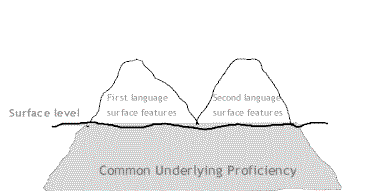
This representation also demonstrates one view of how linguistic knowledge is stored in the brain. One way of thinking of this is to consider bilingual speakers as having separately stored proficiencies in each language, and this may include pronunciation, vocabulary and grammar in the working memory, which in turn, have access to long-term memory storage that is not language specific. In other words, the use of the first or second language is informed by the working memory, but the concepts are stored as underlying proficiency.
Cummins also describes language proficiency in terms of surface and deeper levels of thinking skills. He argues that the deeper levels of cognitive processing such as analysis, synthesis and evaluation are necessary to academic progress. He distinguishes these aspects of proficiency from what he describes as more explicit or superficial realisations of linguistic and cognitive processing. Cummins proposes a minimum threshold of first language cognitive/academic development necessary for success in second language learning. Cummins also suggests that if the threshold of cognitive proficiency is not achieved, the learner may have difficulties achieving bilingual proficiency.
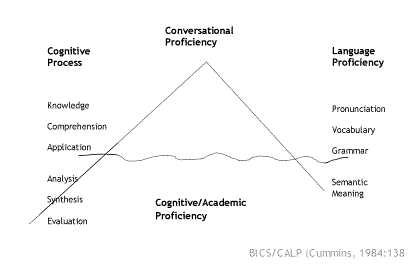
This representation of bilingual proficiency would also suggest that continued conceptual and linguistic development in the first language would help second language learners in their learning of the second language. So the continued support of the first language whilst learning the second language would be beneficial for cognitive development as well as for other socio-cultural reasons. In his later work, Cummins (2000) presents the work of many other researchers which support this hypothesis and the claim that bilingualism and continued development in the first language enhances metalinguistic skills and development in proficiency in the second language.
Threshold Hypothesis
The threshold hypothesis assumes that a child needs to achieve a certain level of proficiency or competence in the first or second language to take advantage of the benefits of bilingualism. A minimum threshold needs to be achieved if there are to be any benefits from bilingualism, and this hypothesis posits that if there is a low level of competence in both languages there may be negative consequences. Sometimes this has been referred to as semi-lingualism, but this term and description is not often used nowadays. It would seem that there needs to be a minimum level of linguistic and conceptual knowledge in the first language to successfully add a second and develop bilingually. At the upper threshold, 'additive bilingualism' occurs when 'balanced bilinguals' have age appropriate competence in both languages. This conceptualization of bilingualism is often depicted as a steps in a ladder or floors in a house. This threshold hypothesis cannot be defined in absolute terms, rather it is a theoretical description, but it can help in explaining the development of bilingual learners. It also supports the arguments for the benefits of additive bilingualism and bilingual education.
There are several implications and benefits of additive bilingualism for teaching and learning. For example, bilingual education may provide the greatest support for bilingual learners in the development of their second or additional language. It is important that new input is connected to the learner's previous knowledge, including linguistic, conceptual and learned knowledge. It would seem that additive bilingualism has positive consequences for learners' metalinguistic development, learning of additional languages and more generally, for learners' verbal cognitive operations. The threshold hypothesis also suggests that both languages must be given an opportunity to develop if there is to be a long-term positive impact. Additive bilingualism brings with it many positive attributes that can enable learners' linguistic and academic development.
Bilingual Education
Unlike the UK, there is a wide variety of education programmes for bilingual pupils in other countries. Bilingual education can be defined as an educational programme in which two languages are used to provide instruction. As with the term bilingualism, bilingual education is a simple label for a complex phenomenon. An important distinction is between those programmes that use and promote two languages and those where bilingual children are present, but bilingualism is not fostered in the curriculum. Skuttnab-Kangas (1984) offers three broad categories that encompass the range of education programmes. Other educationalists have further refined and developed these categories (Baker, 1993).
Immersion programmes promote additive bilingualism for majority language speakers.These are highly valued educational programmes and the most well known are the French immersion programmes for English speaking children in Canada. Although teaching is provided in the second language, the teacher knows and may use both languages.
Submersion programmes are programmes where linguistic minorities are taught through the medium of the majority language with minimal or no support to enable learners to understand the language of instruction nor access the curriculum content. Often the minority languages and cultures are not highly valued by the majority group.
Maintenance programmes provide teaching in the first language in order to maintain use of the home language and culture. These programmes are often allied to transitional bilingual education programmes where the learners gradually move towards full use of the majority language. Examples can be found in the United States where, until recently, transitional bilingual education in Spanish and English was widely available. Transitional bilingual education programmes vary in the amount of first language instruction provided and the duration of the programme. Early exit programmes are where pupils move rapidly to English only instruction, for example, within the first one or two years.
Most bilingual education programmes have two goals; the acquisition of the language of the country and academic success; and the continuing development of the heritage language. Many bilingual education programmes can be defined as a way of using the first language to accelerate second language acquisition.
In the United States, Thomas and Collier (2002) compared the outcomes of different teaching programmes available. They concluded that bilingual education and dual language programmes were the most effective ways to empower EAL pupils to be successful students in the English language mainstream.
Debates around bilingualism and bilingual education are proliferating in the context of globalization and the rapid spread of English. For many, bilingual education is important to the maintenance of first language and culture, whilst at the same time promoting the academic achievement and future success of children. For others, bilingual education has become an issue in socio-political debates about nationalism, integration and identity.
The Bilingual Learner
Any discussion of bilingualism and the bilingual learner must also take into consideration the individual learner. As children learn language they also learn through language about relationships and social structures. They begin to learn about the culture into which they are born. It is through language, in the everyday interactions with the family, peers and school, that culture is transmitted to the child. In this context the learner’s sense of identity develops and language is central to this process. However, what happens when that culture is overlaid with other cultural influences, as happens in larger urban areas where diverse populations mix and change? From the historical perspective, a bilingual learner could be defined in terms of the cultures in which he or she functions, with the home language and culture playing a significant role in his or her life. Teachers may describe their learners as Indian, Polish or Somalian as a proxy label to indicate their bilingualism and biculturalism. But how do teachers define the child of Chinese or Pakistani heritage who has grown up in London or Birmingham, who identifies with the peer group and youth culture and for whom the heritage culture is one that is associated with grandparents and history? Notions of cultural identity that are part of the debate and discussion of bilingualism must change along with our changing society.
Large numbers of ethnic minority pupils in British schools have spent a significant proportion of their lives in Britain and use everyday colloquial English with ease. Many of these pupils may have reached a 'plateau' in which they do not seem able to make further progress in English. Current systems in education continue to identify such pupils as one-dimensional bilinguals speaking a minority language at home whilst learning English at school. These concepts may be little help for teachers in developing adequate teaching approaches and strategies. Harris (1997) argues that we should rethink the ‘romantic’ notion of bilingualism and take a more realistic look at what we call ‘bilingual learners’ in face of the multilingual and multiethnic youth who inhabit a world where language, culture and ethnicity are fluid and change from generation to generation. His interviews with pupils about their language use reveal a complex linguistic and cultural picture of these bilingual and plurilingual pupils:
"My first language is English. I read, write, speak and think in English. I also speak Gujarati because my mum and dad are Gujarati first language speakers...my mum speaks to me in Gujarati and I answer back in English, which is common."
"I know Punjabi, Urdu, Swahili, German, English and Arabic. I can speak Punjabi perfectly and understand it very well. I know a lot of German, and I know how to speak it, and understand it and write it mainly. I know Arabic very little but can write a little bit of it."
The NALDIC series of pupil portraits written by serving teachers provide further accounts of the language affiliations and learning of bilingual learners in schools.
References and Further Reading
Baker, C. (1993) Foundations of Bilingual Education and Bilingualism. Clevedon, Philadelphia : Multilingual Matters Bialystok, E. (2001) Bilingualism in Development: Language, Literacy and Cognition. Cambridge : Cambridge University Press
Cline, T. & Frederickson, N. (Eds.) (1996) Curriculum Related Assessment, Cummins and Bilingual Children. Clevedon : Multilingual Matters
Cummins, J. (1984) Bilingualism and special education. Clevedon : Multilingual Matters
Cummins, J. (2000) Language, Power and Pegagogy. Clevedon : Multimlingual Matters
Harris, R. (1997) 'Romantic Bilingualism: time for a change?' in Leung, C. & Cable, C. (Eds.) English as an Additional Language: Changing Perspectives. Watford: NALDIC
Rampton, B. (1990) 'Displacing the "native speaker": Expertise, affiliation and inheritance' in ELT Journal 44, pp. 97-101
Skuttnab-Kangas, T. (1984) Bilingualism or Not? Clevedon : Multilingual Matters.
Thomas, W.P., & Collier, V.P. (2002). A national study of school effectiveness for language minority students' long-term academic achievement. Santa Cruz, CA: Center for Research on Education, Diversity and Excellence, University of California-Santa Cruz.
Author
Charlotte Franson
Last updated 15 February 2011
Archive resources
Bilingualism and second language acquisition
What is Bilingualism?
Bilingual language acquisition
Bilingual Education
The Bilingual learner